
Prof. Rachel Oliver
Rachel talks about her research interests, what she likes about nitrides, and her career so far.
Download Rachel's researcher profile as a pdf.
Contact details and more information on Rachel's research
How did you join the Cambridge Centre for Gallium Nitride?
I first started working with the GaN Centre as a graduate student. I was trying to grow nitride quantum structures and the growth system I was using in Oxford didn't allow me to access appropriate conditions, so my supervisor organised for me to come and spend some time growing crystals in Cambridge. Menno Kappers and I got some great results, and Colin Humphreys was sufficiently impressed with our joint work that he asked me to apply for a post-doctoral fellowship to come and continue my quantum structures work after I finished my PhD. I thus joined the Centre in 2003 as a Junior Research Fellow, funded by Peterhouse [1] and the Royal Commission for the Exhibition of 1851 [2]. That meant that I was essentially working as an independent researcher right from the start, pursuing my own ideas, but I wouldn't have had enough funding to make progress if it hadn't been for support from Colin and the rest of the Centre. I've been really lucky to have that support throughout my career.
What is your role in the GaN group?
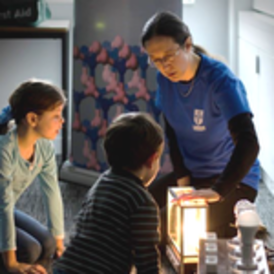
These days, my job title is "Reader in Materials Science". (After another Fellowship, I successfully applied for a permanent position as a "Lecturer" in 2009, and was promoted to Reader in 2013). That doesn't tell you a lot about what I actually do at all though! Essentially, I lead various research projects. (I also teach undergraduates and graduates). I try to ensure that the required funding is in place, generate ideas for new experiments or lines of research and supervise the students and post-doctoral scientists who perform most of the laboratory work. I am not in the lab all that much myself anymore, but I get a really good view across the science that the Centre is doing, and I can sometimes draw together strands or spot new ideas because of that.
What do you like best about working in the group?
The thing I used to like best was working in the lab! These days, I most enjoy discussing data with the researchers in my team and finding new ways to analyse it. I'm perhaps quite unusual, because I really enjoy it when I come up with an idea, and other members of the team find good ways to use the data to test my idea and show me why it's flawed. That's the way we make progress!
Where do you see nitrides in future?
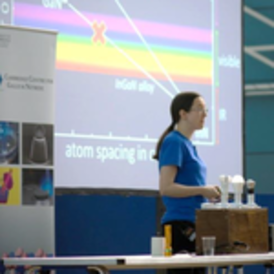
There are so many different applications of these materials! However, I'm personally most excited about quantum light sources. I developed the first indium gallium nitride single photon source, and have been really pleased to see that field taking off in the last couple of years. A single photon source is a light source which produces exactly one and only one photon on demand. That may not sound very useful, but it's actually a key technology to enable some amazing applications like totally secure communications using light.
[1] https://www.pet.cam.ac.uk/news/research-fellowships
[2] http://www.royalcommission1851.org/
For more information about Rachel's research work, you can view her research web page and her LinkedIn page.